 AI FactScan
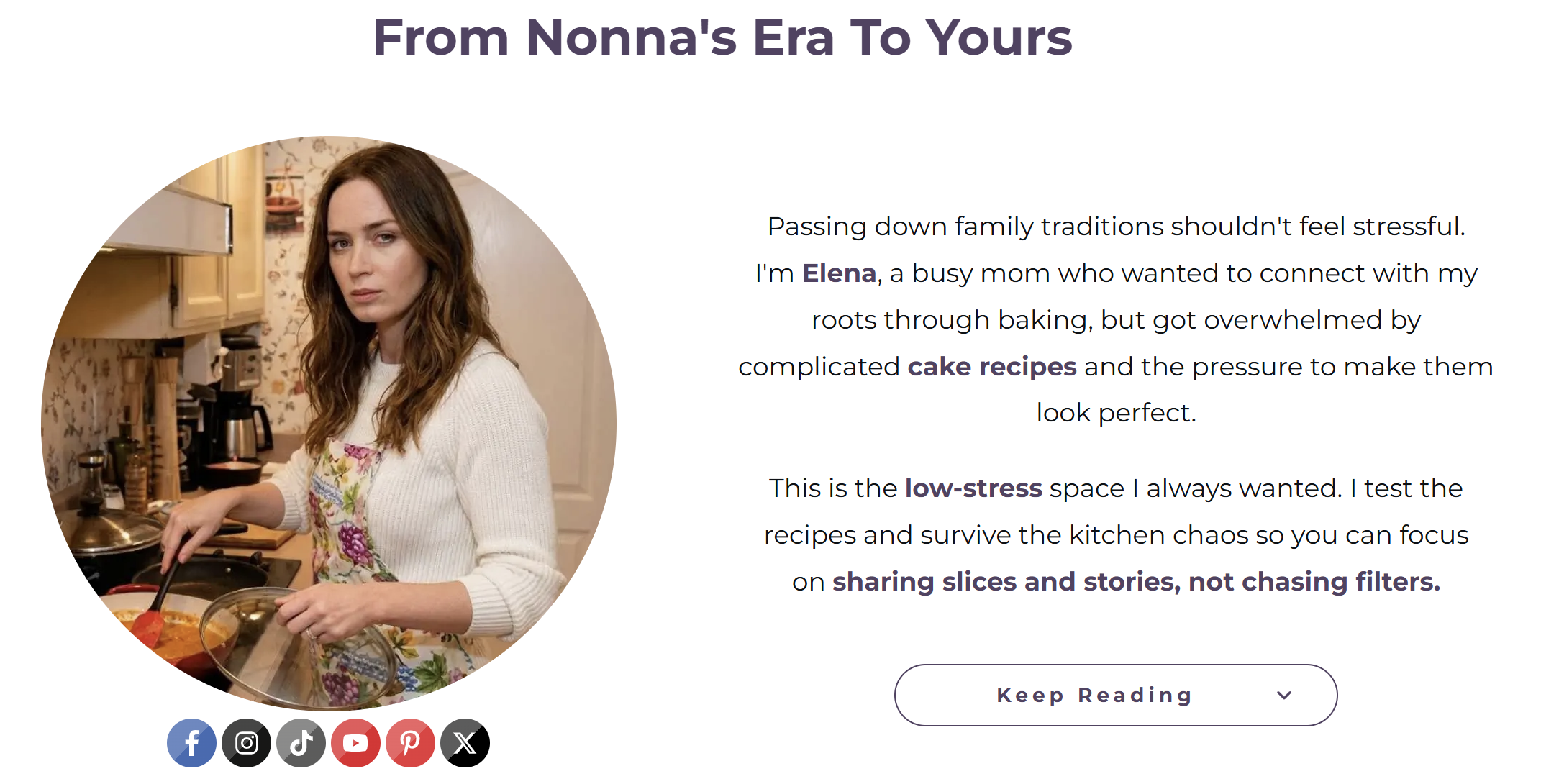
On AddCakes, Elena describes herself as a busy mother who uses simple cake recipes to reconnect with family memories and encourage nervous beginners. She has social accounts, a personal story, and even warm family photos around the dinner table.
There is just one problem: Elena probably does not exist.
Investigators of the advertising supply chain at DecryptAds found that AddCakes' photo of “Elena” appears to have been generated or altered from the face of British actor Emily Blunt. The site also supplied her with kitchen photos, family pictures, and a life story. What looks like a trustworthy baker may instead be an automated publishing operation attached to an advertising account.
How a Fictional Chef Becomes a Business
How Investigators Found 2,116 AI Recipe Sites
Between July and October 2026, DecryptAds identified roughly 400 suspected AI recipe sites connected to particular advertising technology supply chains. The team then expanded the investigation using more than 190 technical fingerprints, including advertising accounts, page identifiers, DNS records, domain registration data, and shared site configurations.
The resulting list contains 2,116 sites. According to the report, a site had to show both an author photo generated by AI and signs of text written by AI, with researchers manually reviewing at least three pages on each site.
Why Make Recipes Nobody Has Tested?
Recipes work well in search and travel easily through visual social feeds. One appetizing photo can pull a reader in from Pinterest, Facebook, or Google. Once there, the reader may have to pass banners, video ads, and popup ads before reaching the ingredients. The operator never has to bake the cake. The page only has to win the click.
DecryptAds found ads from Adobe, HBO Max, Siemens, Subaru, The Wall Street Journal, LinkedIn, Pepsi, and other brands on these sites. That does not mean the brands chose to support fake recipes. Programmatic ads pass through layers of resellers, and advertisers may not know where an impression ultimately appears.
In this business model, the recipe does not need to work. If the image earns a click, the page holds attention, and the ads load, the content has done its job.
Content Farms Aren’t New. AI Made Them Cheap to Scale.
Content farms predate generative AI. They have long chased popular keywords, stitched together articles or bought cheap copy, then turned search traffic into advertising income. Volume mattered more than quality.
AI slop pushes that model much further. Author portraits, personal histories, photos of finished dishes, and social posts can now be generated together, allowing one automated system to produce many sites that appear to have different owners. Research published by Harvard Kennedy School’s HKS Misinformation Review also found that some Facebook pages increased their output after generative image tools became widely available, using striking AI images to build reach before sending people to content farms or scams.
Old content farms sold cheap information. AI adds cheap identities too, lowering the cost of deception and making the operation easier to copy at scale.
Don’t Let AI Slop Into Your Kitchen
A useful name for these sites is “deceptive AI content farms” or MFA sites made for advertising. They invent authors and testing stories, produce recipes at scale around search terms, and turn readers’ clicks and attention into advertising revenue.
For the operator, an attractive photo of a finished dish may be enough. Nobody may have checked the ingredient ratios, whether the steps can be followed, or whether the result is safe to eat. The reader who buys the ingredients and spends an afternoon cooking may become the recipe’s first real tester.
The evidence shows widespread use of fictional authors, material generated by AI, and advertising arbitrage. It does not show that one criminal group controls all 2,116 sites. DecryptAds instead found multiple sellers and operators.
AI slop is already cluttering search results. On a recipe site, it can leave the screen and reach your dinner table.
The Real Risk Is Believing Someone Is Accountable
A bad recipe may ruin dinner and waste a few ingredients. The same production system can also generate medical advice, legal guidance, travel information, or investment content. A fictional author gives unsupported material a warm, professional face while leaving no real person accountable for it.
Claims such as “I’ve made this family recipe for ten years,” “reviewed by a professional nutritionist,” or “personally tested” naturally lower a reader’s guard. Generative AI makes fake experts cheap to create, while search engines and social platforms bring them an audience.
That changes what source checking requires. A working URL, a live page, and a byline are only the first checks. You also have to ask: Is the author a real person? Is there a traceable editor or publisher behind the site? Has anyone actually cooked this dish?
How to Spot an AI Recipe Content Farm
- Check the author and photoSearch the name, background, and other published work. Then run a reverse image search with Google Lens or a similar tool. A profile that exists only on one site, or a photo taken from a stock library, another cook, or a celebrity, deserves closer scrutiny.
- Look at the publishing volumeIf one “personal blogger” publishes a dozen complete recipes a day, each with polished photos and a long backstory, automation is a more likely explanation than extraordinary productivity.
- Check the ingredients, quantities, and stepsWatch for ingredients that never appear in the instructions, implausible temperatures or cooking times, and photos of finished dishes that do not match the recipe.
- Find another traceable sourceCompare the recipe with an established food publication, a printed cookbook, a professional organization, or a creator who shows the full cooking process.
What AI FactScan Can and Cannot Do
AI FactScan can identify source domains, content farm signals, repeated citations, and general site quality. That helps keep these pages from being treated like official institutions or established media simply because they appear in a source list.
It cannot taste the result for you, and one photo cannot prove that an author is fictional. Use source ratings to decide which links deserve attention first, then return to the content, the author, and the original evidence.
A Beautiful Kitchen Photo Doesn’t Mean Anyone Cooked There
Few people used to investigate whether a recipe writer was real. Now AI can generate a chef persona, a family story, photos of finished dishes, and hundreds of articles in one operation. The fabrication is no longer one wrong sentence. It is an entire virtual kitchen designed to look lived in.
The next time a recipe looks too perfect, do not preheat the oven just yet. Checking the author may matter more than checking the baking time.