 AI FactScan
AI summaries are already part of everyday search
Pew Research Center found that 60% of U.S. adults read the AI summaries shown at the top of search results. You may be one of them. For many people, an AI-written answer now appears before the first website they choose to open.
The appeal is obvious. A summary is faster than comparing five tabs, easier to read than a research paper, and usually written with enough confidence to feel settled. That convenience changes how we read. When an answer is clear and well organized, we are less likely to stop and ask where each claim came from.
This is where the risk begins. The same presentation that makes a useful summary easy to absorb can also make a weakly supported answer look trustworthy.
So, can you trust an AI summary?
Sometimes, but it matters how the summary was made. Summarizing one known document is different from piecing together an answer from a web search.
A 2025 randomized trial found that AI-assisted summaries of Cochrane reviews performed about as well as human-written ones. There was an important safeguard: people checked the summaries and corrected errors before the trial.
Most AI answers on the open web do not come with that kind of review. They can mix material from several pages, leave out uncertainty, or place a real citation beside a claim the source never made. A link may work perfectly and still fail to support the answer.
A real citation can still be a poor match.
A 2025 Nature Communications study tested citations in medical answers. In one evaluation of 300 consumer health questions, GPT-4o with retrieval produced valid citation URLs, yet only 38.4% of complete responses had full citation support. The figure belongs to that medical test, but the lesson travels: link validity and claim support are separate checks.
Clear writing can hide uncertainty
AI answers rarely look unsure. They arrive neatly organized and ready to use, even when the sources are mixed or incomplete. The more important the decision, the less you should rely on tone alone. A health choice, legal filing, investment decision, paper, or client report deserves a closer look.
The Answer Bubbles study examined 11,000 real search queries across several AI search products and Google Search. It found that AI summaries often sounded confident while giving less space to uncertainty. In other words, the writing can feel settled before the evidence is.
How to verify an AI summary
Do not begin by checking every sentence. Start with the claims that would change your conclusion, and ask what evidence each one rests on.
1. Make the sources visible
If the answer has no citations, ask for direct links to the original studies, official records, or primary documents. A claim without a traceable source cannot be checked from the answer alone.
If citations are present, open the sources panel before assuming that the number beside it represents independent evidence. Several links may lead to the same article, the same organization, or a search results page.
2. Scan the cited sources
AI FactScan provides a quick first pass. Open the extension, choose Select manually, and click the AI answer containing the citations. The extension extracts the links and checks them together.
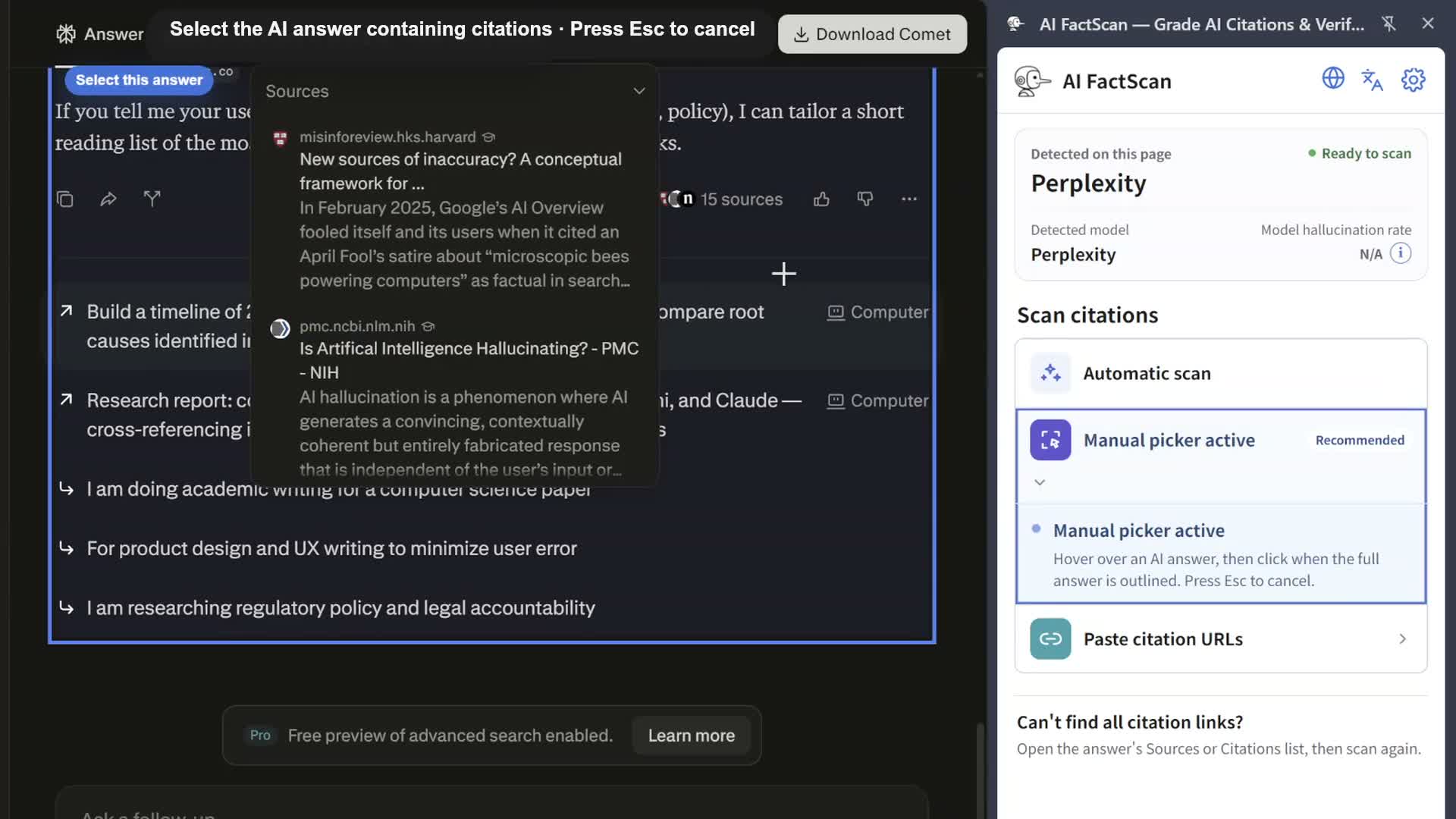
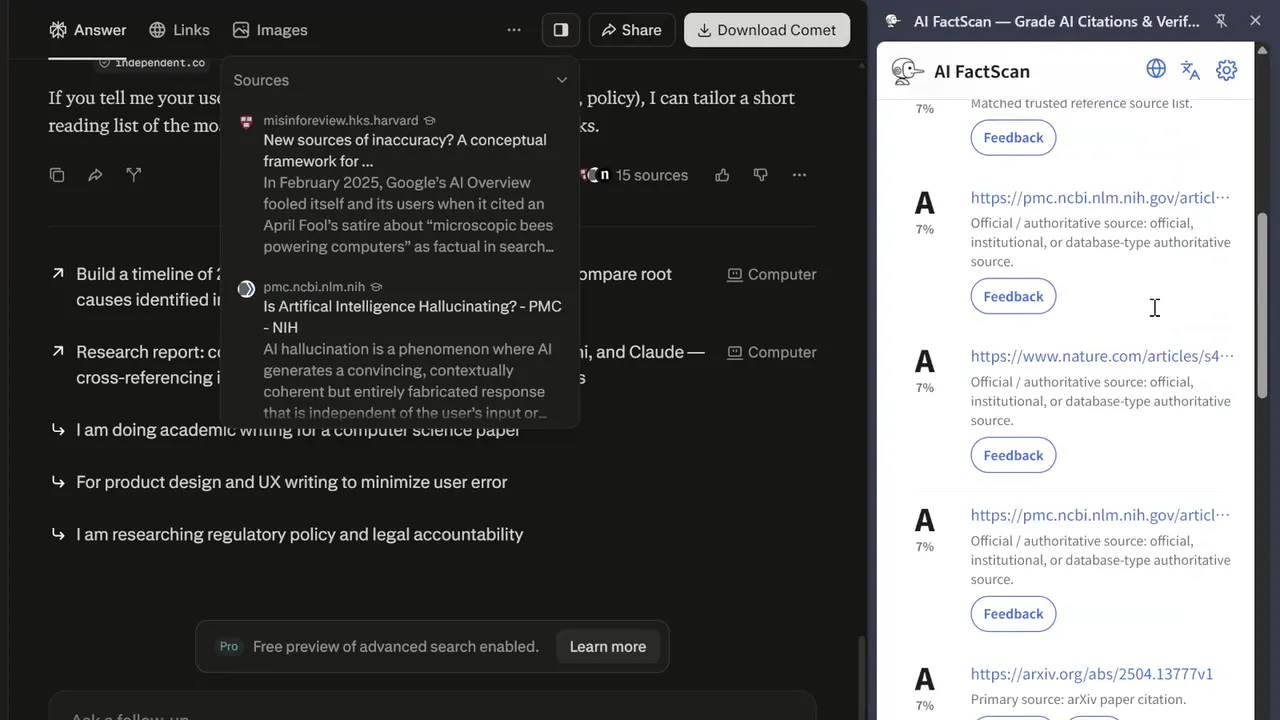
The video shows the complete workflow: select the answer, scan its citations, review the grades, and open a source for verification.
3. Read the result as a priority list
The A-F grades are not a verdict on the whole answer. They help decide where to look first. An official record or established research source deserves different treatment from a random blog, a self-reference, or an identifier that cannot be found.
Also check whether the answer repeats the same article under several links and whether its sources come from a narrow set of domains. Ten citation markers do not necessarily represent ten independent pieces of evidence.
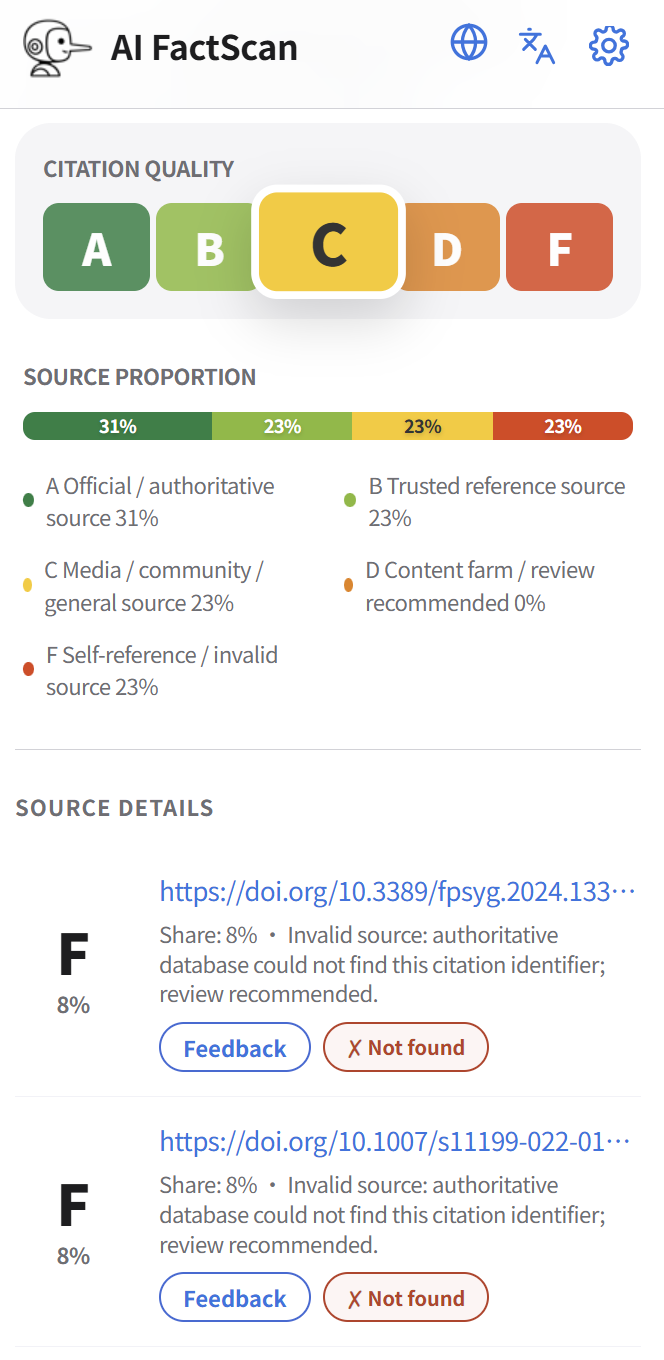
Try this source check with AI FactScan for Chrome.
4. Open the source and compare the claim
This is the part no grade can finish for you. Find the passage, table, result, or limitation that the AI appears to rely on. Then compare it with the wording of the answer.
- Does the source make the same claim, or only discuss the same topic?
- Did the AI turn an association into a cause?
- Did it drop a limitation, date range, sample size, or condition?
- Is the cited page reporting somebody else's study rather than presenting the original evidence?
If you cannot locate the support, do not solve the problem by asking the model whether it is sure. Return to the source.
What AI FactScan does in this process
AI FactScan handles the source triage: extracting citation links, checking identifiers such as DOI, arXiv, and PubMed, grading source types, and showing repeated articles and source diversity. It gets you to the material that needs attention.
Reading decides the rest. A respected journal can publish a study that does not support the sentence in front of you. A lower-ranked source may still contain the exact primary document you need. The final judgment comes from matching the claim to the source.
Three questions before you use the summary
- Can I trace the important claims to real sources?
- Are those sources suitable for the decision I am making?
- After reading the relevant passages, would I state the claim the same way?
An AI summary can save time. Verification determines whether it deserves to save you any more.