 AI FactScan
The short answer
- Google Search is easier to audit because you can inspect its sources separately.
- AI Overview is faster, but it chooses and summarizes evidence before you see it.
- For health, legal, financial or business decisions, open the sources before relying on the conclusion.
We asked Google's own AI
We gave Gemini a direct comparison question:
Which should I trust: Google Search or Google AI Overview? Include the latest research.
Gemini's answer was reasonable. It said neither should be trusted blindly. Traditional Search leaves the evidence visible, while AI Overview adds another layer of interpretation.
Then we scanned the answer's citations with AI FactScan.
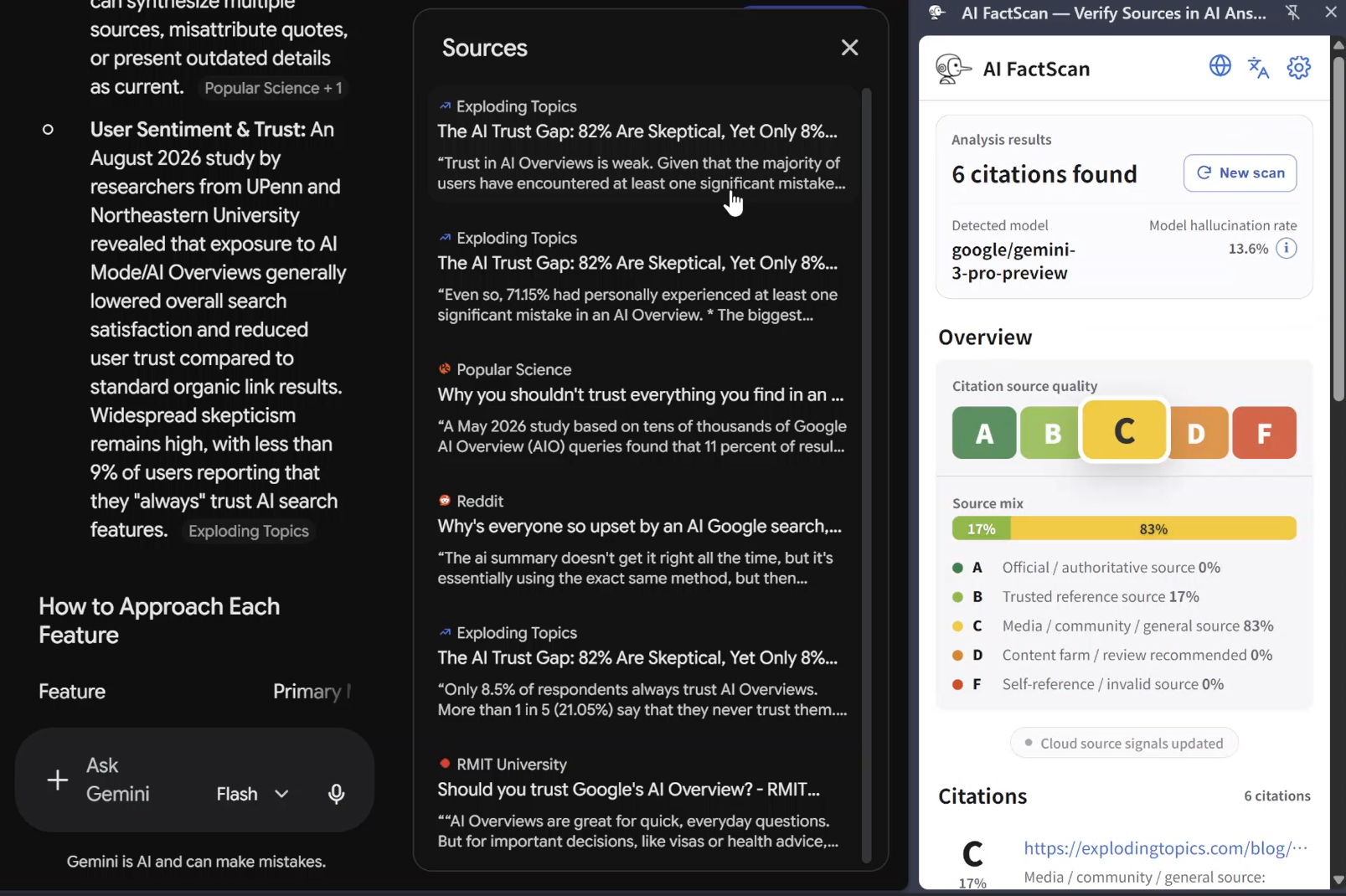
What a C grade means: the citations are media, community or general web sources. They may provide useful context, but they are not primary research or official evidence, so their relevance and support should be reviewed before relying on the answer.
The answer asked for research. The citations did not deliver it
Gemini returned six citation rows, but only four unique pages. One industry blog appeared three times. The remaining links led to a media article, a Reddit discussion and a university news release.
None of the six citations linked directly to a research paper. The answer may still contain correct points, but its source list did not match a request for the latest research.
Google Search and AI Overview do not use the same slice of the web
A 2026 study accepted at ACM SIGIR compared traditional Google Search, AI Overviews and Gemini across 11,500 queries. The average overlap among the sources returned by the three systems was below 0.2.
Traditional Search was more likely to retrieve popular or institutional government and education sites. AI Overviews and Gemini were more likely to retrieve Google-owned content. AI Overviews were also less consistent across repeated runs and more sensitive to small changes in a query.
An AI Overview is not the first page of Google rewritten into a paragraph. It can be built from a substantially different set of sources.
Read How Generative AI Disrupts Search.
A credible source can still fail to support the answer
A second 2026 study issued 55,393 Google queries and split AI Overview responses into 98,020 individual claims. AI Overview cited domains were, on average, more credible than the other first-page results displayed beside them.
But 11% of the claims were unsupported by the cited pages. Most failures came from missing context. And a reputable source was no guarantee that the specific claim beside it was actually supported.
A respected site can be a good source in general and still be the wrong evidence for a particular sentence.
Read Measuring Google AI Overviews. This paper is currently a preprint under review.
Why AI Overview needs a different kind of trust
Google Search gives you ranked pages and leaves the comparison to you. AI Overview selects sources, extracts passages, combines claims, omits details and writes a conclusion before you inspect the evidence.
That convenience is the product. It is also the additional point where an error can enter.
Neither one deserves blind trust
A New York Times report described a benchmark in which Google AI Overviews answered about 91% of questions correctly. That is a strong score, but it still leaves room for errors. Traditional Search also returns weak, outdated or irrelevant pages and leaves you to judge them.
Use Search to inspect evidence and AI Overview to get oriented, but treat neither as a final authority. Check more closely when the answer affects your health, legal position, money, academic work or business. Start with three questions:
- Did the AI cite primary or authoritative sources?
- Did it repeat one article several times and make the source list look larger?
- Does the type of evidence match what you asked for?
Scan first, then verify what matters
AI FactScan grades the cited sources, flags repeated and questionable references, and shows the source mix before you open every tab. That first pass helps you decide where to spend your attention.
Source quality is not the same as factual truth. It is the fastest place to start when an AI answer gives you more links than time.