 AI FactScan
Imagine that an AI tool has helped you finish an essay. The response is clear, the statistics sound specific, and the citations look complete. Then your teacher asks a simple question: "What does the original source actually say?"
You open the link. It leads to a general homepage, a search page, or a paper that discusses the topic without supporting the claim. Sometimes the study cannot be found at all.
The writing looked finished. The learning was not.
AI is already part of how students learn
The OECD's PISA 2025 results cover more than 760,000 students across 91 countries and economies. Among students in OECD countries, 46% said they use AI chatbots at least weekly to help them learn.
That is no longer a fringe habit. Students use AI to explain a difficult concept, generate ideas, summarize a reading, draft text and begin research. These uses are not equally helpful. PISA found that students who used AI for schoolwork tasks such as summarizing, drafting or research had lower average science scores than students who did not. General weekly AI users, however, performed similarly to non-users, and students who also had opportunities to learn AI literacy sometimes performed slightly better.
This is an association, not proof that AI caused the difference. The report's more useful point is that the result depends on what the student asks AI to do.
The real risk is skipping the difficult part
Learning often happens during the slower work: comparing two explanations, following an argument, noticing a limitation and deciding whether the evidence is strong enough. A fluent summary can make that work feel unnecessary.
PISA 2025 found that average reading scores across OECD countries fell by 28 points between 2015 and 2025. It also reported weaker performance in evaluating information, connecting material across sources and thinking critically about what was read. The share of students showing "hasty reading," reading quickly but inaccurately, nearly doubled to 9% between 2018 and 2025.
These trends began before today's AI chatbots became common, so they should not be blamed on one technology. They do show why handing more reading and synthesis to AI deserves attention. The skills most easily outsourced are also the skills students need to practise.
AI can shorten the search. It should not remove the reading.
Why source checking belongs inside learning
Source checking can sound like a final compliance step, something done after the real assignment is finished. In practice, it is part of understanding the subject.
When you open a source, you have to ask what kind of evidence it contains, who produced it, when it was published and whether it supports the exact claim. That brief check can expose a missing condition, an old statistic or a conclusion that the AI made stronger than the study did.
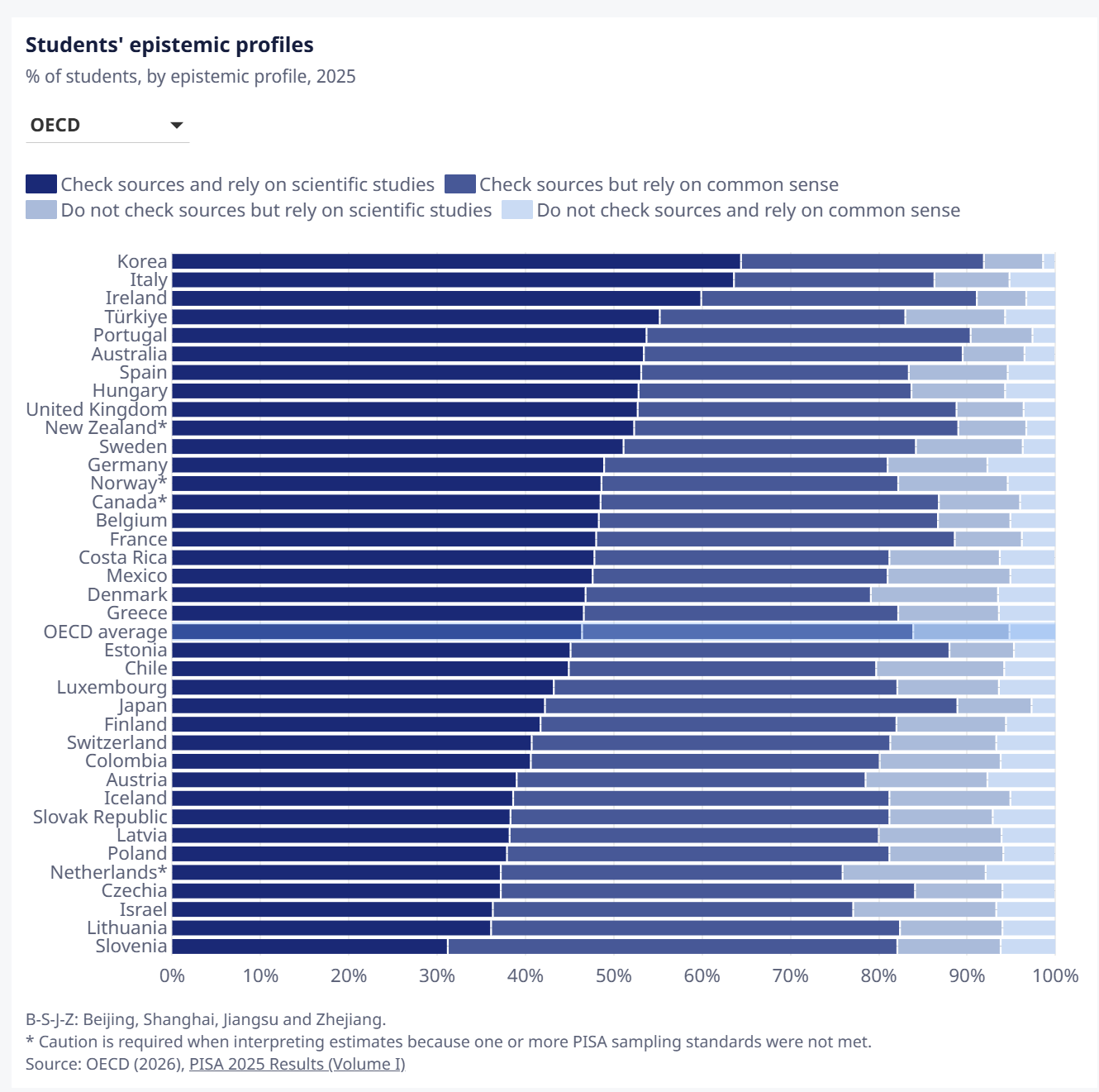
On average across OECD countries, fewer than half of students (46%) reported both checking the credibility of information sources and placing more trust in scientific evidence than in common sense. Another 37% said they checked sources but still relied on common sense. Eleven percent trusted scientific evidence without verifying the source, while 5% did neither. The OECD concluded that a large share of 15-year-olds may be vulnerable to misinformation and disinformation.
The figures point to a gap in students' ability to check information. Finding a link is only the first step. Students also need practice judging whether the source is credible and whether its evidence supports the claim.
How to check sources in three steps with AI FactScan
- Ask for sources you can open. Request direct links to original studies, official reports, primary documents, DOI records, PubMed pages or arXiv papers. An answer with no traceable source is a starting point, not evidence.
- Scan the complete answer. Open AI FactScan, choose manual selection and select the answer with its citations. The extension extracts the links, checks research identifiers, grades the source types and shows repeated articles and source diversity. Begin with anything marked Not found, lower-grade sources and repeated links.
- Open the source and read the relevant passage. Check whether it makes the exact claim, whether the result is described accurately and whether the AI omitted a limit, date, sample or condition. Use the source grades to set your reading order, then bring what you find back to the AI and question the answer.
Try this source check with AI FactScan for Chrome.
What the tool can do, and what remains your job
AI FactScan can make citations visible, check whether common research identifiers resolve, sort sources by type and flag a narrow source mix. That reduces the time spent opening every link blindly.
It cannot read a study for you and decide whether the AI interpreted it correctly. A reputable journal can still be cited for the wrong claim. A government report can still be outdated or taken out of context. The final judgment comes from reading.
Keep the useful part of AI
AI can be useful for getting unstuck, testing an explanation or finding a place to begin. The problem starts when a polished answer ends the inquiry.
A better habit is simple: let AI help you find the path, then inspect the evidence yourself. You will catch weak citations, but you will also understand the material well enough to explain why you used it. That is the part of the assignment worth keeping.