 AI FactScan
Flight delays and schedule changes are stressful enough. When a connection is at risk, most travelers reach for their phones and search Google for the airline's customer service number. That shortcut can now lead straight to a scam call center.
1. The airline number Google showed led to a scammer
The Points Guy reported what happened to traveler Marcia Hannon. She was helping a group of six travelers in their 70s and 80s manage a tight connection from Boston to Geneva after the airline changed their itinerary.
The phone number printed on their ticket no longer worked, and the airline's chat showed 47 people ahead of her. Hannon searched Google for help. The person who answered claimed he could change the tickets and refund the old ones.
He then emailed a credit card authorization form carrying the Swiss International Air Lines logo. Soon after Hannon signed and returned it, American Express alerted her to an attempted $4,500 charge from WHOP, a digital marketplace with no connection to SWISS. American Express flagged the transaction before it went through.
2. Can you trust a customer service number in Google AI?
Do not rely on the AI summary alone. For an airline, hotel, cruise line, or booking platform, get the number from the company's official website, app, booking confirmation, or ticket.
3. How do fake numbers get into Google AI Mode?
The numbers are not always made up by the AI itself. Google AI Mode and AI summaries generate answers from webpages and PDFs in the search index. Once a spam document has been indexed, its fake number can become source material for an AI answer.
The Points Guy found fake numbers on pages hosted by UC Merced, Rutgers University, the U.S. Office of the National Coordinator for Health Information, and even a page hosted by Google. The pages were removed after they were reported.
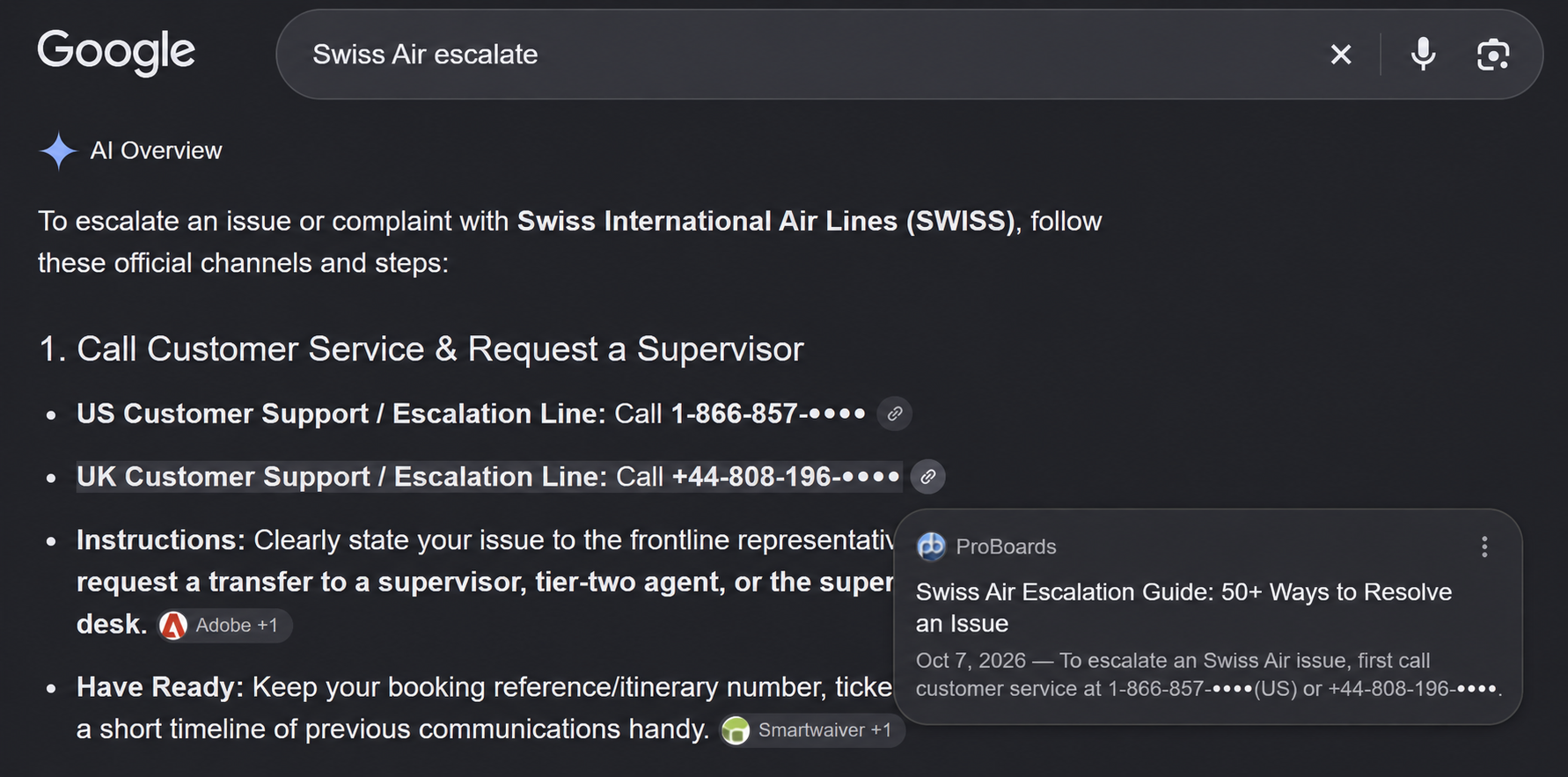
We repeated the search with “Swiss Air escalate.” Google AI Overview still presented two numbers as U.S. and U.K. support lines for SWISS. Its cited sources were ProBoards, Adobe, and Smartwaiver, a mix of forums and platforms that publish user submissions. None was the official SWISS website.
4. How scammers use university and government sites to spread PDFs
This operation does not always require breaking into a website. Check Point found that public forms, upload systems, job portals, and tools for submitting documents on university, government, nonprofit, and commercial sites can all be abused to publish spam.
Scammers produce large batches of PDFs stuffed with airline names, refund keywords, and fake support numbers, then submit them through those public tools. Search engines can index the files, and a document hosted on a .edu or .gov domain may look more credible than it is. The domain owner has not necessarily reviewed the uploaded file.
5. From spam PDF to AI recommendation
The path usually looks like this:
Check Point found the campaign impersonating more than 20 major travel brands. The same pool of numbers appeared across hosted documents, social posts, and summaries generated by AI.
6. Why didn't antivirus software stop the files?
Traditional malware scanners usually do not flag these PDFs. The files contain no exploit code, malicious macros, or executable payloads. They contain ordinary text, search keywords, and a fraudulent phone number. Check Point rechecked confirmed samples with 61 to 64 antivirus engines, and none detected them as malicious files.
Content moderation, upload controls, systems that detect search spam, and checks for topic relevance can still reduce the risk. A scanner built to find malicious code, however, has little to inspect in an ordinary phone number.
7. A .edu or .gov address only tells you where the file is hosted
An airline refund line on a government website, a cruise support PDF on a university server, or a guide to changing tickets on a medical clinic's site should all raise questions. A .edu or .gov address identifies the host. It does not certify every public upload stored there.
8. Before you call, check these details
- Find customer support inside the brand's official website or app.
- Compare the number with your booking confirmation or electronic ticket.
- Do not dial a number solely because it appears in an AI summary or an unfamiliar search result.
- Check whether the source makes sense. A university or government office has no reason to process an airline refund.
- Hang up if the caller asks for gift cards, cryptocurrency, a verification code, remote computer access, or a fee to “unlock” a refund.
9. What to do if you already called a fake support line
- Call your card issuer immediately. Report the transaction, freeze the card if needed, and ask the issuer to block any pending charge.
- Contact the real travel provider. Check whether your flight, hotel, or other reservation was changed or canceled.
- Change compromised credentials. If you shared a password or identity document, update important accounts and enable 2FA.
- Report the fraud. In the United States, file a report at ReportFraud.ftc.gov and use IdentityTheft.gov if identity information was exposed.
10. Where AI FactScan helps
AI FactScan lists the URLs cited in an AI answer and grades each source from A through F based on its type. In this test, the citations were clustered around forums and platforms that publish user submissions rather than the official SWISS website. That mismatch becomes visible before the user trusts the confident wording of the answer.
After the first pass, open the sources that look out of place, come from content farms, or lead nowhere. Check the page topic, publisher, and update date. For customer service and payment details, compare the result with the brand's official site, app, or booking documents.
AI FactScan shows what the answer relied on, so you can spend your verification time on the sources that deserve it most.